Have you ever been a bit bewildered when hearing the buzzwords “AI,” “machine learning,” or “deep learning”? You are most definitely not on your own. These terms are everywhere! Tech blogs, news articles, sci-fi movies; however, they are usually intermingled, which can contribute to the confusion. They are all interrelated, but they are not the same, and this blog will distinguish Artificial Intelligence (AI), Machine Learning (ML), and Deep Learning (DL) while keeping it simple for beginners, with some practical examples so that you can really understand! Let’s demystify it!
What Is Artificial Intelligence (AI)?
AI is the overarching term for all things artificial intelligence. It refers to any computer system that can do things typically requiring human intelligence, such as reasoning, solving problems, or understanding language. Think of it as the broad goal of making machines “smart” enough to mimic human “thinking”. For example, when you ask your virtual assistant to remind you of something, or a chess-playing program beats a grandmaster, that is AI in use. It is not about a specific approach, but rather the overall goal of creating intelligent systems. AI can take the form of anything from a very basic rule-based elaboration (think chatbot from 1982) to a very sophisticated system that learns and adapts.
Takeaway: AI is the overall field of creating smart machines that is made up of many approaches from logic to learning systems.
What Is Machine Learning (ML)?
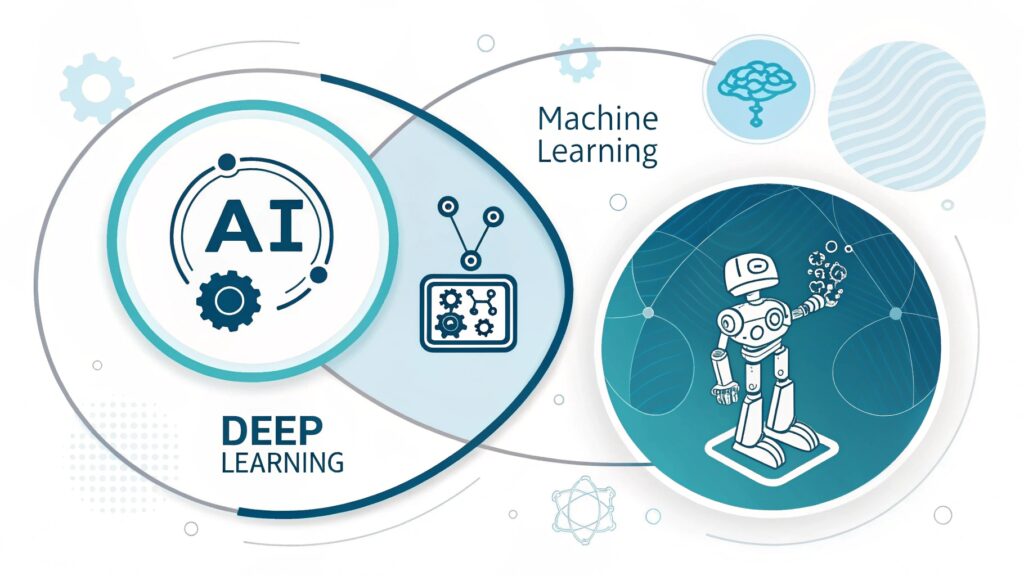
Machine Learning is a subfield of AI. Machine Learning is one method of achieving AI, as we teach computers to learn from data without programming explicit actions for particular tasks. Rather than defining a program by an “If X… do Y” scenario, a machine learning algorithm allows the computer to determine the “If… then…” based on similar examples.
Here’s how it works: you provide an ML system with a significant amount of data, e.g., thousands of “spam” and “not spam” emails. The system will review the data, determine patterns to associate with “spam” (e.g., which known words or phrases exist in the “spam”), and build a model that allows it to predict if a new email is spam. As it goes, the system becomes better as the algorithm improves through more examples.
An example: Netflix recommends a show that you will like. It studied your viewing patterns and compared them with patterns in the viewing data of others to figure out what it thinks you will like.
Key takeaway: Machine Learning is a technique of AI that deals with systems that learn from data to make predictions or provide actions.
What Is Deep Learning (DL)?
Deep Learning is a specialized version of Machine Learning, which itself is a type of AI. Deep Learning uses a technique called neural networks, which are based on an abstraction of how the human brain processes information. Neural networks share information across a set of layers, which are tiled together with interrelated “nodes” that effectively process each piece of data and allow the machine-learning system to learn about ever more complex relationships.
Deep Learning works best when we have a vast amount of data and the task is extremely complex, including face detection in photographs and real-time translation of languages. When your phone’s camera identifies your friend in the photo among a dozen people in a group shot, you are likely using a deep learning algorithm. The algorithm has used millions of photographs, passing the data through the layers of its neural network to learn the patterns of facial features.
The most significant difference between DL and ML is that DL usually requires less assistance from human engineers. In traditional ML, engineers would manually define features (e.g., specify that the system looks for specific words in spam emails), but DL can learn the important features with sufficient amounts of data and computing resources.
Key Point: Deep Learning is a powerful type of Machine Learning that uses neural networks to tackle complex tasks, often with less manual setup but more data and computing resources.
Real-World Examples to Clarify
Let’s look at a single task—identifying a dog in a photo—to see how these terms apply:
- AI: A system that can identify a dog in a photo, whether it uses simple rules (e.g., “look for four legs and a tail”) or advanced learning techniques.
- Machine Learning: A system trained on a dataset of dog photos, where engineers might highlight key features (like size or fur color) to help it learn to spot dogs.
- Deep Learning: A neural network trained on millions of photos, automatically learning to recognize dogs by analyzing tiny details (like whisker patterns or eye shapes) without needing specific instructions.
Why Does This Matter?
Understanding the differences helps you make sense of the tech world’s buzzwords. Here’s why each is important:
- AI is the vision driving innovation, from self-driving cars to smart home devices.
- Machine Learning powers many of the practical AI tools we use, like recommendation systems or fraud detection in banking.
- Deep Learning is behind cutting-edge advancements, like real-time language translation or medical image analysis that can spot diseases faster than humans.
Each level builds on the others, and together, they’re transforming industries and our daily lives. However, they also come with challenges, like ensuring AI systems are fair, transparent, and don’t misuse data. Knowing the distinctions helps you ask better questions about how these technologies are built and used.
Wrapping It Up
AI, Machine Learning, and Deep Learning can be compared to layers of a technology cake, with each adding its own unique flavor to the world of intelligent machines. As you will see, AI is the high-level concept about making systems smart, Machine Learning is the way we get systems to learn from data, while Deep Learning is itself a method that abstracts and expands the way we represent our data and understand complex problems using neural networks. Now, when you hear the term AI, Machine Learning, or Deep Learning, you have a better understanding of what they mean – and how they all play a part in making our world more intelligent and connected.
From smartphones saving us time and effort to smart auto manufacturing, AI, Machine Learning, and Deep Learning are all part of the same family of techniques, collaborating to help make our lives fantastic! Stay curious, and continue to explore the world of technology – it will only get more interesting from here!